What VARK Means and Why It Matters
Educators and trainers increasingly look for evidence-informed ways to personalize instruction without overwhelming planning time or budgets. At the heart of this search sits VARK, a concise framework that maps how people tend to engage with information through four channels: Visual, Aural, Read/Write, and Kinesthetic. Rather than boxing learners into rigid categories, it surfaces tendencies that can guide communication choices, lesson sequencing, and assessment formats. Originating in the 1990s through Neil Fleming’s work, the approach remains widely referenced because it is straightforward, memorable, and flexible enough to blend with modern learning science such as dual coding, cognitive load management, and retrieval practice.
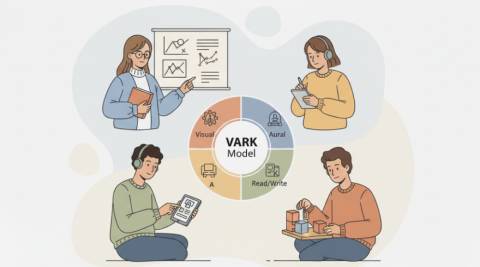
Developed by Neil Fleming, the VARK model groups preferences into four modalities used across classrooms and workplaces. This lens does not replace pedagogy or curriculum design; it complements them by clarifying how a message can be delivered so it resonates. Visuals like diagrams and spatial layouts help many learners synthesize relationships rapidly. Spoken explanations and dialogue strengthen comprehension for those who benefit from tone, cadence, and conversation. Dense text and structured notes support learners who thrive on precision and exact wording. Hands-on experimentation and real-world simulation catalyze understanding for people who learn by doing. By deliberately layering modalities, instructors build redundancy that improves encoding, reduces ambiguity, and supports transfer of knowledge.
- Visual: charts, concept maps, annotated screenshots, process flows
- Aural: lectures, podcasts, debates, peer teaching
- Read/Write: glossaries, briefs, checklists, summaries
- Kinesthetic: labs, role-plays, case walkthroughs, prototypes
Core Modalities Explained with Practical Examples
Clarity grows when the four preferences are described with concrete, everyday scenarios. A visual preference often surfaces when people say, “Show me the big picture,” and reach for whiteboards or dashboards. Aural-leaning learners may recall content best after discussion, office hours, or audio notes. Those who favor text tend to request written specifications, meeting minutes, and well-structured documentation. Kinesthetic-leaning learners will ask to try a new tool, manipulate data, or simulate a process to discover how it behaves under constraints.
Many educators shorthand the four preferences as VARK model learning styles when discussing study tactics with students and training participants. In practice, most people are multimodal, and preferences can shift with context, task complexity, fatigue, or stakes. A software onboarding course, for instance, might combine a feature tour video, an illustrated workflow, a concise step-by-step guide, and a sandbox exercise. A sales enablement sprint might blend call listening, objection-handling scripts, interactive role-plays, and annotated slide decks. The plurality of touchpoints creates cross-reinforcement, which helps novices, supports non-native speakers, and bolsters inclusivity without diluting rigor.
- Visual practice: storyboard complex processes before coding or writing
- Aural practice: schedule micro-briefs, huddles, or voice memos to reflect
- Read/Write practice: convert discoveries into SOPs and living docs
- Kinesthetic practice: run tabletop exercises and quick prototypes
Benefits for Learners and Organizations
When instruction aligns delivery with preference, friction drops and engagement rises. This does not mean designing four separate courses; it means enriching core materials so each concept appears in two or more complementary forms. Such redundancy can decrease time-to-competency, reduce remediation, and increase knowledge retention. It also dovetails with Universal Design for Learning (UDL) by offering multiple means of representation and action while preserving clear outcomes. In busy workplaces, small changes, like adding a diagram to an SOP or a narrated summary to a policy update, yield outsized gains.
In evaluation reports, the VARK model of learning often supports clearer alignment between objectives, activities, and assessment rubrics. Leaders can connect the dots between performance gaps and modality coverage, then invest in targeted improvements rather than sweeping rewrites. Teams frequently report benefits such as higher completion rates in e-learning, fewer support tickets after product training, and better formative assessment scores. Learners, in turn, experience greater autonomy by choosing the path that fits them, watch a demo, read a one-pager, or jump into an interactive task, while still hitting the same standard.
- Faster onboarding and fewer errors in procedural tasks
- Improved recall through dual coding and spaced review
- Higher participation in discussions and reflective practice
- Stronger transfer from training to on-the-job performance
- More equitable access for diverse backgrounds and abilities
Applying VARK in Courses and Training Programs
Implementation succeeds when VARK principles are baked into templates, not added as an afterthought. Start by mapping a week or module and marking where each modality appears. If visuals are abundant but hands-on practice is thin, add a quick lab, simulation, or case. If talk tracks dominate, provide written briefs and annotated references. For synchronous sessions, alternate mini-lectures with whiteboarding, short readings, and experiential activities so attention resets and energy stays high.
For course design sprints, teams can treat the VARK learning model as a checklist to balance visuals, narration, text, and hands-on labs. The quick-reference below provides concise cues and tactics you can adapt to your LMS, instructor guides, or microlearning assets.
| Modality | Common cues | Quick strategies |
| Visual | Asks for diagrams, wants the “big picture” | Use maps, flows, annotated screenshots, color coding |
| Aural | Thinks aloud, prefers discussion or podcasts | Add brief lectures, debates, voice notes, read-alouds |
| Read/Write | Requests specs, checklists, and documentation | Provide summaries, SOPs, glossaries, step-by-steps |
| Kinesthetic | Wants to try it, seeks demos and practice | Run labs, simulations, role-plays, tangible examples |
- Pair each major concept with at least two modalities
- Design formative checks that vary: quiz, demo, explainer, brief
- Leverage job aids so learning extends beyond the session
- Capture feedback by modality to guide continuous improvement
Assessment, Adaptation, and Data-Driven Improvement
Diagnostics help learners reflect on how they absorb information, yet no survey should become a gatekeeper. Use preference inventories as a conversation starter and triangulate with observation, performance data, and self-reports over time. When dashboards show a cluster of missed steps, investigate whether the representation was narrow: Was there only a paragraph where a diagram or demo would have clarified the sequence? Did a policy rely on a slide deck when a reference card would have aided the application?
When building adaptive pathways, analysts sometimes reference the VARK learning style model to label clusters in their dashboards. A practical routine is to A/B test two or three representations of the same idea, then monitor completion time, error rates, and retention. Over successive cohorts, you can retire underperforming assets and scale those that consistently drive outcomes. Encourage metacognition by asking learners to journal how they approached a task, what representation helped, and how they would explain the concept to a colleague. These reflections surface patterns that inform instructional tweaks and strengthen autonomy.
- Collect modality-specific feedback after each module
- Track impact metrics: accuracy, speed, transfer, confidence
- Iterate assets with version control and lightweight pilots
- Align modality choices to task complexity and risk level
FAQ: Clear Answers for Practitioners
Is VARK a replacement for pedagogy or curriculum design?
No, the framework serves as a delivery lens that complements strong pedagogy. It helps you choose how to represent ideas, but it does not set goals, sequence standards, or define mastery. Pair it with sound instructional design, aligned objectives, and valid assessments.
Are people only one type in this framework?
Most learners are multimodal and flex by context, stakes, and prior knowledge. Preferences can shift during a project, across disciplines, or as expertise grows. Use the framework to diversify representation, not to label people permanently.
How do I start using the framework in a busy course?
Audit one unit, identify the dominant representation, and add a complementary form. For example, attach a diagram to a dense brief or create a short demo for a policy update. Small changes compound and require minimal prep once templated.
What research-informed practices pair well with this approach?
Combine it with dual coding, retrieval practice, spaced repetition, and worked examples. These methods improve encoding and retrieval while the framework ensures that messages are accessible through multiple channels.
How should I measure impact after making changes?
Define a few concrete metrics, accuracy on critical tasks, time-to-competency, and transfer to job performance. Compare cohorts before and after changes, gather qualitative feedback, and iterate assets that consistently improve outcomes.
Conclusion: Build Multimodal Learning That Scales
Personalization becomes sustainable when it is systematized, not improvised. A simple inventory of representations, plus lightweight metrics, will reveal where to add a diagram, script a mini-brief, supply a reference page, or create a quick hands-on practice. Over time, templates embed these choices into your workflow so every module earns better clarity, stronger engagement, and measurable performance gains. The result is a learning ecosystem that respects individual preferences while holding high standards for everyone.