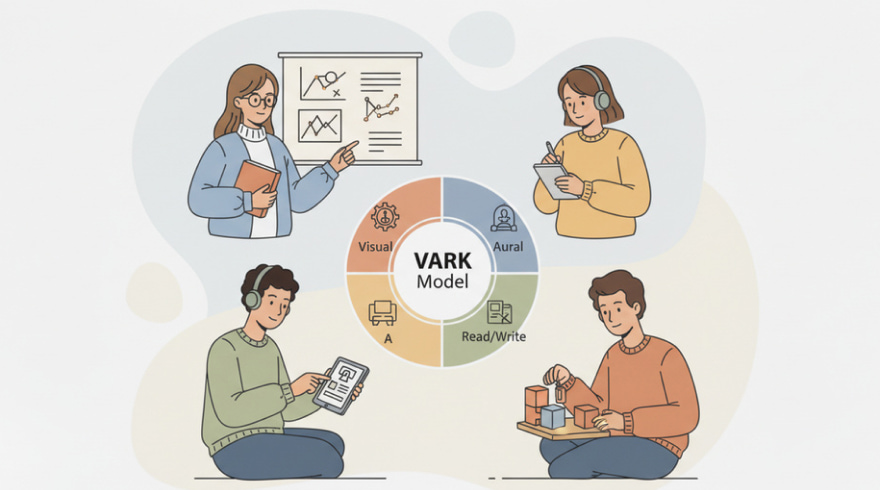
What Is VARK and Why Does It Matter
Across classrooms, training rooms, and online platforms, people notice that some explanations click immediately while others feel opaque. The VARK framework gives a shared language for describing how individuals prefer to take in information through visuals, sound, reading and writing, or hands-on activity. Rather than boxing people in, it supplies a flexible map that helps learners and instructors choose the right route for a given journey. When used thoughtfully, this approach encourages metacognition, improves engagement, and makes study time more efficient.
Educators often ask what makes a style framework useful beyond buzzwords and quick quizzes. At its core, the VARK model of learning aligns instruction with perception pathways so that explanations, examples, and practice tasks resonate more quickly for diverse audiences. This alignment reduces extraneous cognitive load, giving working memory room to process ideas and build a durable schema that transfer to new contexts.
Skeptics sometimes worry that style labels can become limiting if treated as destiny rather than preference. In practical use, the VARK learning model works best as a starting point that prompts variety, encourages multimodal reinforcement, and guides learners to experiment with tactics they might not have tried before. The result is a repertoire approach, where people select the right tool for the job and develop agility across modalities without abandoning what feels intuitive.
- Clarifies communication between instructors and learners.
- Supports inclusive lesson planning with purposeful variety.
- Encourages self-awareness about how attention and memory operate.
- Pairs naturally with proven practices like retrieval and spaced repetition.
The Four Modalities in Action
VARK refers to four ways people commonly prefer to receive and process information: Visual (diagrams, maps, spatial layouts), Aural/Auditory (talk, discussion, podcasts), Read/Write (texts, lists, manuals), and Kinesthetic (labs, simulations, real objects). Many people are multimodal, finding that combinations amplify clarity, motivation, and recall. Instructors can blend channels in a single lesson, while learners can remix formats during independent study to strengthen understanding.
When planning instruction, teams often select exemplars, artifacts, and prompts that reflect each pathway. In this context, the VARK model learning styles framework helps translate abstract content into concrete representations that match how audiences prefer to absorb detail. By toggling among images, narratives, concise summaries, and demonstrations, facilitators make complex ideas graspable without diluting rigor.
Learners can apply the same thinking to personal study routines and project work. With intention, a person might pair a concept map with a brief summary and a quick hands-on sketch to reinforce a single idea, which still respects an individual VARK learning style while strengthening versatility. That layered approach leverages dual coding, elaboration, and retrieval practice in a way that feels natural rather than forced.
- Visual: infographics, timelines, flow diagrams, annotated screenshots.
- Aural: peer teaching, voice notes, lectures, live Q&A, story-driven explanations.
- Read/Write: structured outlines, flashcard prompts, comparison tables, manuals.
- Kinesthetic: role-plays, case walk-throughs, prototypes, instrumented labs.
Benefits, Motivation, and Research-Informed Gains
Style awareness should complement, not replace, evidence-based learning strategies. The biggest gains come from blending modality alignment with practices that strengthen memory, such as spaced repetition, interleaving, and self-testing. Instructors can use the framework to make these high-impact practices more approachable, while learners can use it to design study blocks that feel engaging instead of exhausting.
Motivation often rises when learners feel the material speaks their language, and that is where VARK learning fits alongside cognitive science. By presenting ideas in personally meaningful forms, people persist longer, make richer connections, and are more willing to revisit challenging topics with fresh tactics. Small wins accumulate into durable competence when the path to mastery feels clear and actionable.
Organizations also benefit from structured data about preferences gathered through an accessible screening tool. In many programs, a brief intake using a VARK learning styles assessment informs cohort design, resource allocation, and coaching plans without adding unnecessary bureaucracy. Over time, these insights reveal patterns that help leaders deliver targeted support while preserving learner autonomy.
- Boosts early comprehension by matching explanations to perception.
- Improves persistence by reducing frustration in the first mile of learning.
- Supports equitable access through multimodal materials and activities.
- Aligns with assessment strategies that value transfer and application.
Finding Your Profile and Interpreting Results
Discovering your preferences is less about labels and more about finding repeatable ways to make progress. A quick self-check before studying, asking which format would make this concept click fastest, can save time. Over weeks, you can log which combinations work best for different subjects or tasks, then refine your plan with data rather than hunches.
Formal tools can help you start strong and track change over time. Many learners begin with a brief screener such as a VARK learning assessment to establish an initial snapshot they can revisit later. Instructors sometimes run the same process with groups to inform lesson design and to nudge a healthy variety of activity types.
Short, plain-language surveys offer a practical path to clarity and conversation. Programs often distribute a VARK learning styles questionnaire during orientation, then pair the results with guidance on study techniques so that insights translate into action. The point is not to pigeonhole anyone, but to surface choices that make effort more efficient.
| Modality | Recognition Signals | Effective Tactics | Useful Tools |
| Visual | Remembers layouts and colors; prefers maps to paragraphs | Sketch diagrams, color-code steps, convert lists into flows | Whiteboards, mind-mapping apps, annotated slides |
| Aural | Thinks out loud; recalls stories and phrasing | Explain concepts to a peer, record summaries, join discussions | Voice recorder, podcasts, live Q&A sessions |
| Read/Write | Gravitates to headings, lists, definitions | Draft outlines, refine notes, build comparison sheets | Notebooks, text editors, spaced-repetition cards |
| Kinesthetic | Needs to try it; trusts examples and cases | Simulate workflows, manipulate objects, run mini-experiments | Prototyping kits, lab spaces, interactive simulators |
Once you have a snapshot, consider how preference interacts with task demands, prior knowledge, and constraints. Complex skills usually benefit from multimodal reinforcement, so mix channels intentionally. If one route stalls, switch formats, test yourself, and keep a short reflection log to capture what worked so you can repeat it when the stakes are higher.
Study and Teaching Strategies That Stick
Effective learning emerges from the synergy of format and technique. Pair a chosen modality with retrieval practice, spaced review, and elaboration for stronger retention, and use diagnostics to adjust the balance as you go. Instructors can build lessons that cycle through modalities, while learners can remix resources to fit their context, goals, and timelines.
Self-tests are a practical on-ramp to experimentation with style-aligned tactics. Many people start by taking an online screener or a brief VARK learning style quiz before mapping specific study routines for each subject area. That small investment reduces guesswork and highlights a handful of high-yield tactics to try during the next study block.
Course designers can also apply the framework to increase accessibility and clarity across materials. A syllabus that includes icons, short summaries, and interactive tasks supports diverse preferences without diluting rigor, which connects directly to the learning styles VARK perspective on inclusive design. Over a term, this approach builds a shared habit of switching channels to deepen understanding.
- Blend visuals with concise text to enable quick dual coding.
- Use brief explain-out-loud moments to cement key steps and vocabulary.
- Translate dense passages into checklists and comparison sheets before practice.
- Prototype, simulate, or role-play to test understanding under realistic conditions.
FAQ: Answers to Common Questions
What does the acronym represent?
It stands for Visual, Aural/Auditory, Read/Write, and Kinesthetic, describing common channels for perceiving information. In practical use, the VARK learning styles framework highlights preference rather than fixed ability, which helps learners choose suitable tactics without locking them into a single path. Most people discover they are multimodal and can benefit from switching formats as tasks change.
How can I identify my preferences quickly?
A simple starting point is to notice which resources you instinctively reach for when material feels tough, then test alternatives to confirm. Many programs provide a VARK learning style questionnaire that offers a concise snapshot and suggestions, which you can validate through short study experiments. Over time, tracking what works for different subjects sharpens your judgment.
Are style preferences the same as strengths?
No, preference is about comfort and ease of entry, while strength reflects competence developed through practice and feedback. You can become highly skilled in areas that are not your default preference by combining deliberate practice with varied modalities that keep effort sustainable. Treat preference as a guide, not a constraint.
Should teachers redesign every lesson around one modality?
Single-channel lessons risk leaving part of the class behind, so a rotating mix is usually more effective. Thoughtful sequencing that layers diagrams, concise summaries, dialogue, and hands-on practice gives everyone multiple avenues into the same core ideas. Over a unit, that variety supports transfer and makes review faster.
What if my profile changes across tasks or over time?
Shifts are common because task demands, prior knowledge, and context influence what feels most helpful. Rather than chasing a perfect label, maintain a small menu of tactics you can deploy flexibly, and update it as you learn what works. A reflection habit will show patterns you can reuse when the stakes are high.