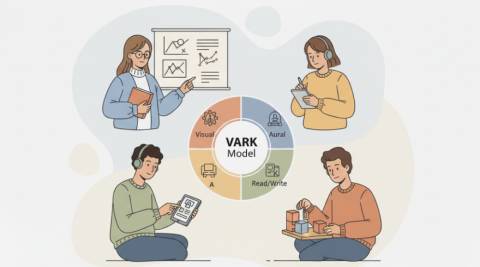
What VARK Is and Why It Matters for Learners and Educators
Learning is not a one‑size‑fits‑all endeavor; people absorb information through different channels, and those channels shape motivation, persistence, and achievement. The VARK framework maps four core modalities, Visual, Aural/Auditory, Read/Write, and Kinesthetic, to help individuals recognize how they most comfortably take in and express knowledge. Rather than boxing anyone into a rigid type, this approach encourages strategic flexibility, so you can choose study techniques aligned to a task, a deadline, or a context. When learners notice how they prefer examples, diagrams, narration, or hands‑on practice, they gain language to request clarity and select tools that reduce friction.
Using a concise questionnaire, the model highlights tendencies that often go unnoticed in busy classrooms and fast‑moving workplaces. Among the most approachable tools, the VARK assessment bridges theory and day‑to‑day study habits without jargon. By revealing a single dominant mode or a multimodal blend, it becomes easier to set up note‑taking methods, collaboration norms, and review routines that energize attention instead of draining it. Educators, trainers, and managers can then refine explanations, remix materials, and vary the medium of instruction to ensure equitable access to understanding.
- Clarifies how to encode, rehearse, and retrieve information efficiently.
- Supports self‑advocacy: learners can ask for diagrams, demos, or summaries as needed.
- Enables differentiated instruction without overhauling entire curricula.
- Promotes metacognition and growth through strategic, evidence‑based study plans.
How the VARK Model Works: Modalities, Signals, and Everyday Study Moves
Each VARK modality captures distinct cues that help information “stick.” Visual emphasizes spatial layout, charts, and symbolic mapping. Aural focuses on tone, cadence, and conversational explanation. Read/Write leans on language‑dense materials like articles, glossaries, and structured outlines. Kinesthetic favors tactile engagement, labs, simulations, and real‑world cases. People often discover a primary mode plus helpful secondary preferences, which together inform how to preview content, capture notes, and review effectively before an exam or presentation.
Short, well‑timed diagnostics can illuminate which mixture feels effortless during complex tasks. For a quick snapshot, the VARK learning assessment groups preferences into visual, aural, read/write, and kinesthetic modes. After identifying a pattern, learners can pair modality‑matched tactics with universal, high‑impact methods like retrieval practice and spaced repetition, creating a potent, personalized routine. Educators can mirror that approach by layering slides, discussions, and practice activities to address diverse needs within the same lesson.
| Modality | Typical Signals | High‑Yield Tactics |
| Visual | Prefers diagrams, flowcharts, and spatial organization | Concept maps, color‑coded notes, annotated schematics |
| Aural | Thinks aloud, benefits from dialogue and storytelling | Recitation, peer teaching, lecture summaries recorded as audio |
| Read/Write | Enjoys lists, manuals, and dense text with headings | Structured outlines, term glossaries, rewrite notes into summaries |
| Kinesthetic | Wants demonstrations, labs, or realistic case studies | Hands‑on practice, role‑play, build‑measure‑learn projects |
- Blend modality‑specific tactics with retrieval practice for durable memory.
- Alternate formats to prevent fatigue and strengthen transfer.
- Use feedback loops to refine which strategies deliver results fastest.
Benefits for Students, Educators, and Teams Across Contexts
Targeted study leads to measurable gains when tactics fit the learner and the task at hand. Students can convert long readings into skimmable outlines, turn lectures into concise audio notes, or translate static slides into mind maps. Teachers can scaffold lessons with pre‑class organizers, in‑class multimodal checkpoints, and post‑class summaries that reinforce key concepts. Managers and L&D leaders can engineer onboarding that respects varied preferences, lowering cognitive load while accelerating performance.
When institutions seek scalable improvement, the VARK learning styles assessment clarifies where instruction can be diversified without inflating workload. The results help stakeholders optimize classroom layouts, choose facilitation techniques, and build repositories of templates that match the top modalities in a cohort. Over time, organizations gain a common language for explaining confusion, diagnosing bottlenecks, and selecting interventions that are easy to implement but powerful in effect.
- Increases engagement by aligning materials with how people naturally process input.
- Improves retention with modality‑matched encoding plus retrieval practice.
- Enhances equity by widening pathways into the same core ideas.
- Strengthens collaboration through shared norms for communication and feedback.
From Results to Action: Interpreting Profiles and Designing Better Study Plans
Insights only matter if they inform concrete behavior. After reviewing modality indicators, translate them into one or two small, testable changes per week. Visual learners might rebuild notes as layered diagrams; aural learners might schedule micro‑explanations with a peer; read/write learners might convert talks into structured briefs; kinesthetic learners might prototype concepts with physical or digital manipulatives. Keep the experiments short, compare outcomes, and double down on what moves grades, quality, or speed.
Before jumping into tactics, the VARK learning style assessment results should be translated into concrete, time‑bound experiments. Add universal principles, spaced repetition, interleaving, and self‑testing, so modality alignment amplifies proven learning science rather than replacing it. Educators can support this process by offering multi‑format study packs and formative checks that help learners calibrate effort to impact, while teams can codify playbooks that make effective behaviors repeatable.
- Pick two tactics per week, measure outcomes, and iterate quickly.
- Combine modality alignment with retrieval practice for compounding gains.
- Document what works in a personal or team learning log to sustain momentum.
Common Pitfalls, Myths, and Best Practices to Keep It Scientific
Misconceptions arise when preferences are mistaken for abilities or destiny. VARK does not claim that only one format “works” for a person; rather, it helps reduce friction so effort flows into understanding, not merely coping. Preferences can shift across subjects and contexts, and multimodal strategies often outperform single‑channel routines. The healthiest posture treats the framework as a practical compass, subject to verification through outcomes like recall, transfer, and performance.
To avoid oversimplification, the VARK assessment of learning styles ought to be treated as a starting map rather than a rigid identity card. Pair it with transparent goals, brief experiments, and honest data: quizzes, drafts, demos, and reflections. Instructors should rotate modalities within lessons to broaden access and train adaptability, while learners build a resilient toolkit that flexes for seminars, labs, remote work, or field practice.
- Do not conflate preference with fixed talent; train across modalities.
- Validate strategies with evidence: scores, speed, and error reduction.
- Refresh your approach each term to reflect new tasks and constraints.
FAQ: Clear Answers to Popular Questions About VARK
How long does the questionnaire take, and what preparation is needed?
Most people finish in under fifteen minutes, and no special preparation is required. Answer instinctively based on what you usually do under time pressure or when material feels difficult. That snapshot is more predictive than idealized responses because it captures the strategies you actually use when stakes are high.
Can someone be multimodal rather than strongly aligned to one category?
Absolutely. Many learners display a blend of preferences that varies across tasks, courses, or work projects. Multimodal profiles can be powerful because they allow quick switching: sketch a map to get oriented, talk it through to refine understanding, then build a prototype to consolidate knowledge and reveal gaps.
How should teachers incorporate results into lesson planning?
A simple pattern works well: preview with a visual organizer, teach with a mix of talk and text, and consolidate with practice that mimics real use. Offer optional materials in alternative formats and include frequent, low‑stakes checks for understanding so learners can select the mode that makes the next step clearer.
What if my preferred mode conflicts with the course format?
Adopt translation strategies. If lectures dominate, convert them to structured notes and brief audio summaries. If texts are dense, rebuild them into outlines and diagrams. When labs are central, narrate steps and write micro‑reports. The goal is to recast the given format into one that your brain processes more fluently.
How do I know the approach is working for me?
Track outcomes you care about: recall after two days, error rates on problem sets, or speed when drafting. Rotate one variable at a time, note format, review method, or practice schedule, and compare results across weeks. Sustained improvements in accuracy, confidence, and transfer signal that your strategy mix is hitting the mark.