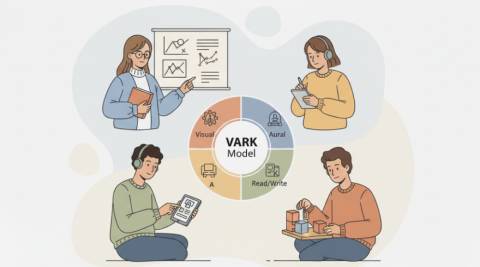
What the VARK Model Is and Why It Matters
Learning feels effortless when the material is presented in a way that resonates with how your brain likes to take in information. The VARK framework organizes these preferences into four approachable modalities: Visual, Auditory, Read/Write, and Kinesthetic. Rather than labeling people rigidly, this model highlights tendencies that help learners and instructors choose tactics that amplify comprehension, recall, and motivation. When used thoughtfully, it reduces friction, clarifies choices, and turns vague study habits into targeted routines.
While motivation and prior knowledge still matter, clarity about format can remove hidden barriers that waste time and energy. Many students and professionals discover that the VARK test acts like a mirror, reflecting back patterns they felt intuitively but could not explain. This simple awareness empowers learners to ask for diagrams, talk through ideas, annotate texts more strategically, or prototype concepts with hands-on trials. The result is pragmatic: fewer rereads, faster “click” moments, and more durable memory traces.
- Visual learners benefit from charts, timelines, sketchnotes, and color-coded frameworks.
- Auditory learners absorb ideas through discussion, recorded explanations, and teaching others aloud.
- Read/Write learners flourish with structured notes, glossaries, outlines, and deliberate paraphrasing.
- Kinesthetic learners connect through labs, simulations, case work, and real-world application.
Perhaps the most useful aspect is that preferences can be blended; many people are multimodal and can switch formats intentionally. With that flexibility, the model becomes a toolkit rather than a rulebook, guiding learners to align the medium with the message and the moment.
How VARK Works: Modalities, Metacognition, and Real-World Benefits
VARK centers on the idea that input format shapes attention and encoding. Visual preference emphasizes spatial layout, white space, arrows, and relational maps. Auditory preference leans on tone, cadence, and conversational meaning-making. Read/Write preference thrives on text density, headings, and personal note transformations. Kinesthetic preference favors action, tactile cues, and context-rich scenarios. Each channel complements the others, and the mix shifts with task type, stakes, and time constraints.
In practice, the model boosts metacognition: learners decide how to approach a topic before beginning, and then they monitor whether the chosen format is working. That simple intervention, plan, test, adjust, prevents passive reading and random tactic switching. Educators, coaches, and managers use VARK to broaden delivery, diversify materials, and give learners multiple entry points into the same concept. This increases perceived relevance, supports accessibility, and promotes equity across backgrounds and abilities.
- Academic impact: clearer lectures, modular notes, multi-format assignments, and better study groups.
- Professional development: richer workshops, applied role-plays, and concise job aids suited to varied roles.
- Self-directed learning: personalized routines, microlearning design, and habit loops that actually stick.
When teams adopt a shared vocabulary for preferences, feedback becomes more constructive. Instead of “this is confusing,” you hear “a diagram would clarify the flow” or “a hands-on example would ground the abstract idea,” which leads to faster iteration and improved outcomes.
Taking the Assessment: Steps, Scoring, and Interpreting Your Profile
Getting started is straightforward: complete a brief questionnaire that presents everyday scenarios and asks which response feels most natural. Tallying responses across Visual, Auditory, Read/Write, and Kinesthetic yields a profile that may lean strongly toward one mode or blend several. The point is not to chase a single “best” result, but to learn which inputs accelerate understanding and which formats you can cultivate for flexibility.
Access options vary by provider, and many organizations include a version within onboarding or study-skills programs. Some learners appreciate that certain online options offer the VARK test free with immediate feedback and simple guidance. Beyond the quick score, interpretation matters most: read the descriptions, compare them with your lived experience, and try small experiments that confirm or refine what the numbers suggest.
| Modality | Common Indicators | High-Impact Study Tactics |
| Visual | Thinks in images; likes maps and schematics | Mind maps, flowcharts, annotated diagrams |
| Auditory | Processes by talking; recalls voice and tone | Explain-aloud, podcasts, Q&A sessions |
| Read/Write | Prefers text density; loves lists and headings | Outlines, glossaries, rephrased notes |
| Kinesthetic | Needs movement or context; trusts examples | Demos, labs, case studies, role-play |
After scoring, translate insight into action. For instance, a visual-kinesthetic blend might pair storyboard sketches with a quick prototype. An auditory-read/write blend might record a concise explainer, then convert the transcript into a bullet-summary. Try one new tactic at a time, measure impact with a brief reflection, and keep what demonstrably improves retention or performance.
Applying Results: Tactics and Routines for Each Preference
Turning preferences into daily habits is where value compounds. Start with the highest-scoring modality to win early gains, then add a complementary format to reinforce memory consolidation. Structure time blocks to match the task: use visual planning for project scoping, auditory discussion for ambiguity, text-based synthesis for precision, and hands-on practice for transfer to action. Mixing modes prevents fatigue and deepens comprehension through varied neural pathways.
- Visual: Convert dense paragraphs into sketchnotes, color code concepts, and use timelines for sequences.
- Auditory: Host five-minute learner huddles, narrate thought processes, and teach a concept to a peer.
- Read/Write: Build a personal wiki, summarize chapters in your own words, and craft checklists for repetition.
- Kinesthetic: Simulate scenarios, manipulate objects or datasets, and rehearse with realistic constraints.
For complex topics, design a loop: preview with your primary modality, deepen with a secondary mode, and cement with a brief retrieval practice session. A visual learner might preview a diagram, discuss key nodes out loud, then write a concise summary. A kinesthetic learner might attempt a small build, annotate what worked, and explain the process to someone else. This triad approach promotes transfer, the true measure of learning in both academic and workplace settings.
Designing Inclusive, Multi-Format Instruction
Instructional design guided by VARK aims to reduce cognitive bottlenecks by offering multiple representations of the same concept. Begin with clear learning outcomes, then map each outcome to at least two formats so learners can choose their entry point. When possible, keep transitions between formats smooth: an overview diagram ties to a brief talk-through, which links to a handout, which culminates in a lab or application task. This redundancy is not waste; it is scaffolding that meets diverse needs.
- Plan content in layers: visual blueprint, auditory narrative, textual reference, and applied activity.
- Use “choice boards” that let learners pick how to engage while meeting the same objective.
- Embed micro-assessments that ask learners to reflect on which format worked and why.
- Provide artifacts: annotated slides, transcripts, templates, and checklists for ongoing support.
When evaluating program effectiveness, track more than test scores. Monitor engagement patterns, question types, and retention across cohorts. If a topic routinely stalls discussion, try switching the primary modality, shortening segments, or building a hands-on demonstration earlier. Over time, you establish a culture that normalizes preference-informed strategies without stereotyping or limiting learners, which enhances access and equity.
Frequently Asked Questions
Is VARK the same as intelligence or personality?
No. VARK describes preferred input formats, not cognitive ability or temperament. Many learners find that the VARK learning style test clarifies how to approach a topic without implying fixed traits. You can develop skill with any modality, and preferences may shift by task, domain, or context. Treat results as guidance for selecting strategies, not as a permanent label.
Can someone be strong in more than one modality?
Absolutely. Multimodal profiles are common, and blending formats often produces the best outcomes. For example, pairing a quick diagram with a short verbal explanation can create a fast path to insight, especially for complex or abstract ideas. Use experimentation to discover your most productive combinations.
How should I study differently after learning my preferences?
Start with your top modality to build momentum, then add a complementary format to reinforce memory. Create a simple routine: preview, deepen, and retrieve. For instance, listen to a concise explanation, take structured notes, and finish with a brief practice problem. Measure results by speed of understanding and accuracy on recall, then refine the routine.
Does the model help in professional training or only in school?
It helps in both. Workplace learning benefits when abstract concepts are translated into multiple representations and grounded in authentic scenarios. Facilitators can provide talk-throughs, job aids, and simulations so every participant finds an accessible doorway into the content. This improves adoption of new tools and procedures.
How do educators apply VARK without stereotyping learners?
Offer choices and encourage reflection rather than assigning fixed categories. Present concepts in at least two formats, invite learners to share what worked, and treat preferences as situational. Over time, learners build versatility while still having a dependable starting point for efficiency and clarity.